
男生女生向前冲
Is the rapid growth of China’s emerging industries driven by industrial subsidies?: People’s Daily_我的网站

A |
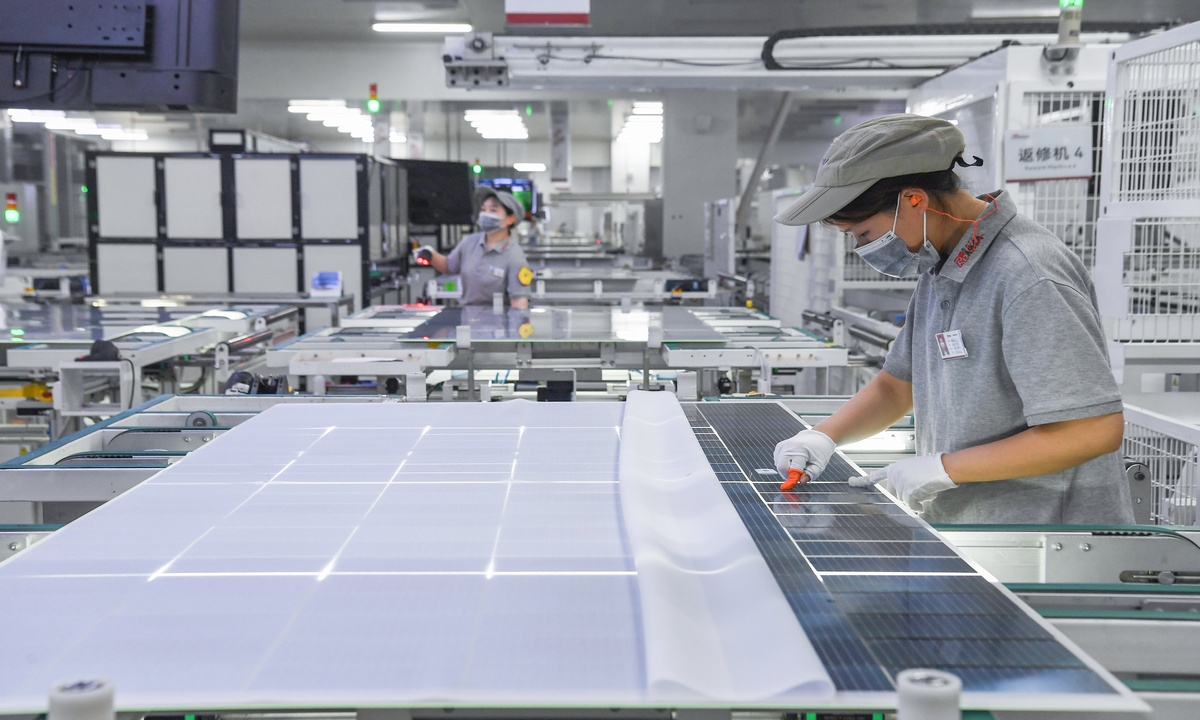
China saw robust exports in electric vehicles (EV), lithium batteries and photovoltaic products, known as the "new three," in the first half of this year. More notably, robotics, artificial intelligence (AI) and innovative drugs, which represent the future direction of industrial development, are also emerging as new calling cards for China's foreign trade.
However, the impressive performance provoked unease among some Western media outlets and politicians. Some have deliberately portrayed China's rapid industrial development and strong competitiveness as a result of government subsidies, pushing the false claim that subsidies have created overcapacity and those low-priced Chinese products are flooding global markets. Such fallacies, which simply equate industrial subsidies with overcapacity, are not only logically flawed but also factually groundless.
In practice, many countries adopt industrial policies tailored to their national conditions and development needs, such as providing research and development (R&D) subsidies for emerging industries and risk related subsidies for agriculture.
Well-designed industrial subsidies can help address market failures, promote technological innovation and environmental protection, reduce poverty and support balanced development, rather than cause so called "overcapacity."
Multiple reports by the United Nations Conference on Trade and Development have noted that the number of industrial policies worldwide has grown rapidly over the past five years, with R&D subsidies, tax incentives and low interest loans for emerging industries becoming common international practices.
Forcibly linking industrial subsidies to "overcapacity" is, in essence, a political manipulation based on double standards. The US, for example, plans to provide $750 billion in various subsidies from 2022 to 2031 under its Inflation Reduction Act. Subsidized EVs are subject to requirements such as production and sales in the US or North America, effectively excluding other WTO members. US industrial subsidies for AI are even greater than those of all other countries combined.
Similarly, according to incomplete statistics, the European Commission is expected to provide more than 1.44 trillion euros ($210 billion) in various subsidies between 2021 and 2030. The EU's Industrial Accelerator Act links local content directly to financial support through "Made in EU" requirements, creating serious investment barriers and institutional discrimination.
Have these massive subsidies been labeled as causing "overcapacity"? The answer is no. While claiming that China's industrial subsidies lead to so-called overcapacity, these countries are themselves providing massive subsidies to their own industries. Such double standards amount to selective accusations targeting China, aimed at politicizing trade and economic issues and weaponizing industrial policy.
At a deeper level, accusations that "China's industrial subsidies cause overcapacity" are merely a pretext, reflecting growing anxiety and fear over the rising competitiveness of Chinese industries.
Looking back at the repeated hype in Western media, the criticism has consistently targeted China's most globally competitive industries, including new-energy vehicles, photovoltaics and power batteries. This exposes the real intention of shifting the blame for their own lagging industrial development onto China while stepping up restrictions against Chinese industries.
China's breakthroughs in these industries have been driven by advances in homegrown technologies, complete industrial and supply chains, and robust market competition, rather than by policy subsidies as some have claimed.
In recent years, China has taken multiple steps to regulate and improve its subsidy policies, from reviewing and correcting inappropriate local subsidies to exploring a unified negative list mechanism for local fiscal subsidies. China applies subsidies equally to all market entities, including foreign invested enterprises, strictly follows WTO rules, and continues to improve the compliance, effectiveness and transparency of its subsidy policies.
Rather than fabricating and hyping baseless claims about subsidies and obsessing over building trade barriers, certain Western media outlets and politicians should focus on addressing their own weaknesses and increasing investment in research and development. They should embrace healthy market competition with an inclusive mindset, promote mutual benefit through greater openness, and win markets and drive progress through genuine innovation.
This was compiled and translated by the Global Times English edition based on an article published in the "Chisu Jinsheng" economic commentary column of the People's Daily on August 10, 2026.
。
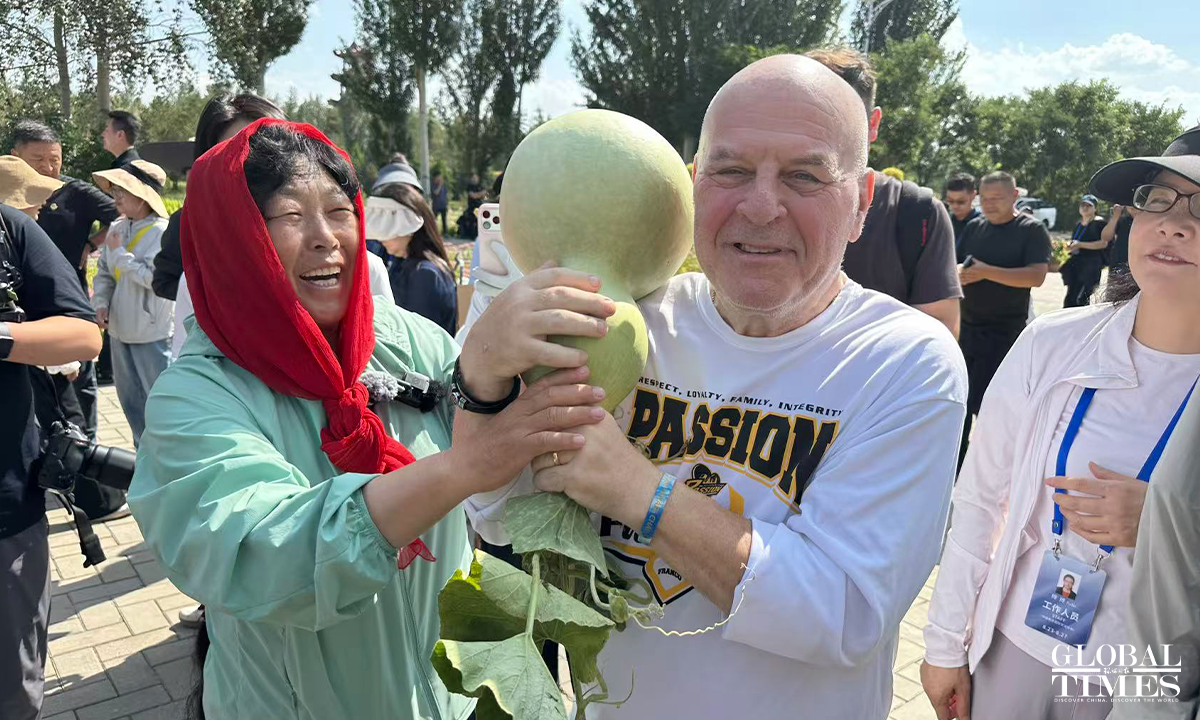
On Monday afternoon, American teacher Ronald Sakolsky visited the homeland of Chinese desert fighter Yin Yuzhen in Uxin Banner of Ordos, Inner Mongolia Autonomous Region. This was a place the American man had visited in 2000 and it has completely changed since then.
In 1999, Sakolsky, a teacher in a China-US education exchange program, was touched by a report on Yin and her husband's afforestation efforts in the harsh wilderness of Mu Us Desert, and raised $5,000 to support her green cause. During that visit, they took pictures - in front of the sunken pit where the Yin couple once resided and in the barren land with a finger-thin sapling they had just planted against a backdrop of dust and bare earth.
What has the $5,000 changed?
On Monday, they came to the Sakolsky forest - a permanent tribute honoring Sakolsky's early contribution to the region's ecological revival - and replicated the vintage pictures, standing in front of a pit that has long been abandoned and beside a newly planted sapling. This time, however, there are bushes and trees in the background.
This contrast not only witnessed their friendship across time and the Pacific Ocean, but also showcased a promise Yin has kept for 27 years and a green dream that has been made possible through generations of joint unwavering efforts from Yin, her husband and countless other sand fighters.
Homecoming with family cooking
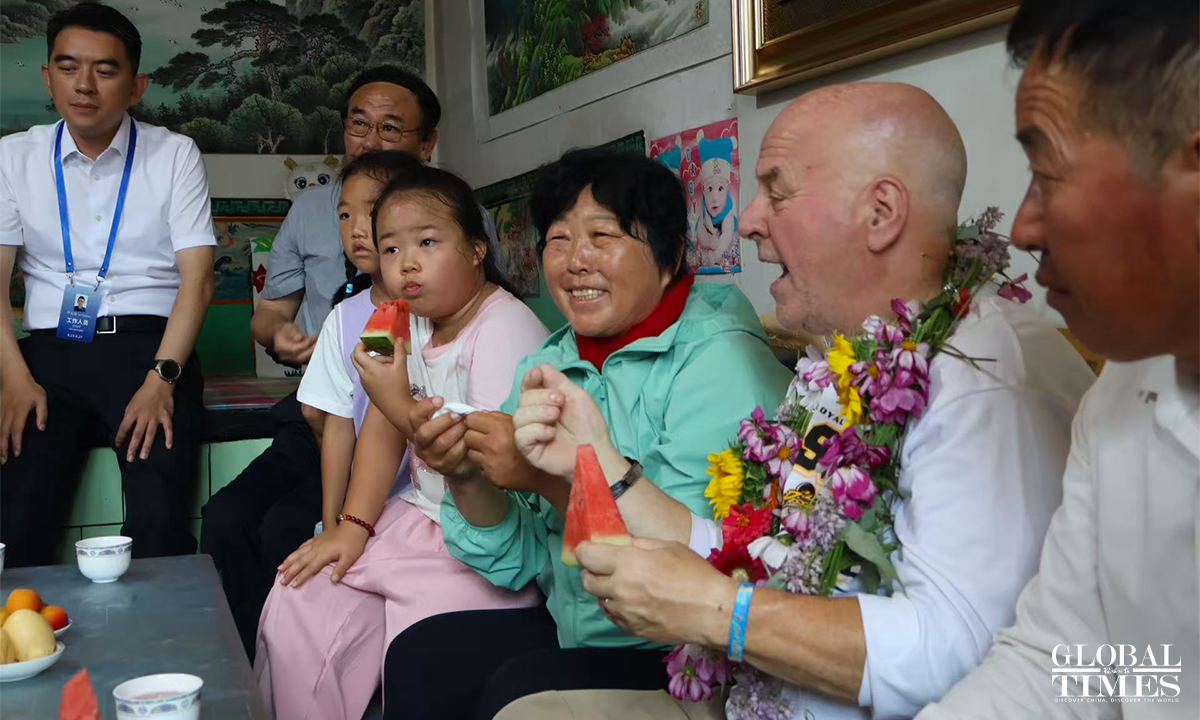
Yin hosted Sakolsky on Monday at her home, filling the air with the aroma of home-cooked meals during their long-awaited reunion. Watermelons were served along with other fresh fruits and vegetables, all harvested locally. Yin told the Global Times earlier that she learned the English word "more" to persuade him to eat more.
In 1999, Yin had few options for showing her hospitality, so she cooked a bowl of plain noodles for Sakolsky. Now, the harsh wasteland has transformed into a vibrant green oasis, thanks to unwavering afforestation efforts.
In the courtyard, the Global Times reporter saw Yin grinning from ear to ear with pride as she introduced the produce from the farmland - green pepper longer than a palm, a bottle gourd even bigger than Yin's head, and bags of foxtail millet packaged with the assistance of Yin's grandchildren, who are proud of the family's generations of commitment to green causes.
During a tour of Yin's home, Sakolsky was impressed by the beautiful house with its green courtyard, saying "You deserve every centimeter of this house." Throughout the visit, he repeatedly praised Yin's hands, which the desert fighter and model worker used to change both the land and her own life through arduous work.
The $5,000 Sakolsky donated in 1999 was equivalent to three years' income for Yin's entire family at the time. Today, that money has grown into more than 50,000 trees.
But Yin's journey did not stop there. Over the following decades, with the support of China's growing ecological restoration policies — including subsidies for afforestation and compensation for forest managers — she transformed the barren land into a productive family forest farm. Her success has inspired many others in the region to take up tree planting and sand control, transforming what was once a desperate struggle into a sustainable livelihood.
From the sandy hollow where the Yin couple lived in in 1985 and the earth hut they resided in until 1993, to the solid brick house Sakolsky saw when he last visited, and the two-story house the big family now lives in, the change in living environment is a clear example of ecological dividends.
Uxin Banner lies in the heartland of the Mu Us Desert. The desertification rate was over 90 percent in the 1950s and forestation coverage was merely 7.2 percent as of 1980. Now, the forestation rate has increased to 33 percent, while plantation coverage has expanded to 85 percent, per official data.
Carry on the greenness, kindness
This miracle would have been impossible without numerous people like Yin, long-term systematic planning and scientific governance.
Chen Ziliang, an expert from the local forestry and grassland bureau, said that Mu Us Desert's sand‑control journey has evolved from collective afforestation to contract desert‑reclamation, moving beyond the simple goal of "keeping trees alive" to restoring vegetation based on water‑resource conditions.
Putting the idea of "lucid waters and lush mountains are invaluable assets" into practice, Uxin Banner no longer views "greenness" and "growth" as an either‑or proposition. On restored sandy lands, the under‑forest economy, eco‑agriculture and eco‑tourism have flourished. Sand‑fixing shrubs are now processed into animal feed and biomass fuel, and local authorities are exploring photovoltaic‑powered desert control, the Global Times learned.
Sand control is no longer just about keeping sand away; it's a development approach that guarantees a greener and better living environment alongside a booming economy and increasing incomes.
On Monday afternoon, when Sakolsky finally stepped into the forest named after him, this American teacher witnessed the Chinese woman's perseverance and commitment to her promises. The $5,000 donated without expectations has grown into a thriving forest of around 50,000 trees.
"A promise is a promise. Ms. Yin fulfilled her promise," Sakolsky said. After 27 years, the wasteland is green, and Sakolsky and Yin are "brother and sister."
"This is the answer to how we guide young people: We must teach them love and perseverance. We need to show young people photos of Ms. Yin planting trees, digging the soil with her bare hands," Sakolsky remarked while packing a jar of sand. He said he planned to bring it back to the US, telling his grandchildren it is not just a jar of sand, but "a jar of love."
Sakolsky told the Global Times earlier that the younger generation only knows about the dust-covered landscape from photos and stories of the elderly. It is important to tell them how the greenness is achieved, and how every single person can contribute to making an extensive forest in the harshest environment.
"I see where China and America can work together. I see it, so I will not quit. She [Yin] never quit. 'Quit' is not in her vocabulary," Sakolsky said with emotion on Monday.
"Chinese and Americans can be family. We can get over the differences if we focus on the similarities... If we focus on our similarities and not our differences, we can solve the problems."
At the end of Monday's schedule, Yin and Sakolsky planted another sapling together, just as they did about three decades ago, but in a completely different landscape.
This new sapling carries on the story of not only greenness through generations of joint efforts, but also kindness across the Pacific Ocean.
。
Current article:http://og6nt5.panningbuquanchencaibingzhang.cyou/k696fo7/lf9ti9v.html
Published on:06:10:03