
lol
China reports 522,000 new COVID-19 cases, one death in July amid fluctuating upward trend_我的网站

A | Great news for Jr NTR fans! Although reports have been doing the rounds from last one month that Jr NTR would resume shooting for his upcoming film, Dragon (tentatively titled), things never took off. But according to the latest reports, the actor has resumed shooting for the action entertainer. Shooting resumes after 4 months Jr NTR and director Prashanth Neel temporarily halted the shooting around August, partially because of the actor’s injury. Jr NTR also reportedly requested script revisions and improvements, wanting to ensure the film’s success after War 2's lukewarm response. The actor believes that with script overhauls and potential re-shoots, they can meet the expectations of the fans and audiences. He wants to further elevate the script and his character arc, even if it means re-shooting some portions, demonstrating his dedication for the film. While Neel was revising the script, Jr NTR utilized the time to build a toned and ripped body that’s needed for one of the shades in his character. With both the actor and director now convinced creatively on the script and are focused on creating a visually stunning epic, the film’s new schedule has resumed in Ramoji Film City in Hyderabad on Saturday. Dragon release to be pushed? A source from the film unit informs, “The makers commenced shooting an action episode featuring NTR and other support cast. The schedule is expected to continue till the end of the month.” Initially, the film is slated for June 2026 release, but the unexpected 4 months delay has pushed the makers to lookout for alternate dates. According to sources, director Prashanth Neel is eyeing 2026 Dasara festive season. Moreover, with the film reportedly being made in two parts, Jr NTR wants to release the first instalment at the earliest. Based on the response, he will take a call on the second part.Also Read: Jr NTR to Get a Stylish Makeover for Dragon; Sparks Fan Frenzy。

China reported 522,000 newly confirmed COVID-19 cases in July, including 487 severe cases and one related death with cases showing a fluctuating upward trend, China's national disease control authority said.
The current uptick in infections represents another regular cyclical wave, with its severity comparable to surges seen in the past two years. The upward growth curve has slowed markedly, and the country is now on the plateau phase of this epidemic peak, said the Chinese Center for Disease Control and Prevention (Chinese CDC) on Thursday.
All tested infection samples were confirmed to be the Omicron variant, with the NB.1.8.1 strain and its sublineages accounting for the majority of circulating cases, the Chinese CDC said.
A Beijing-based respiratory disease specialist told the Global Times that waning population immunity, continued virus mutations that weaken existing antibody protection, and increased summer travel have contributed to the recent modest rise in infections. However, there is no evidence that the virus has become more pathogenic. Nationwide infections appear to be nearing their peak and case numbers may begin falling in late August.
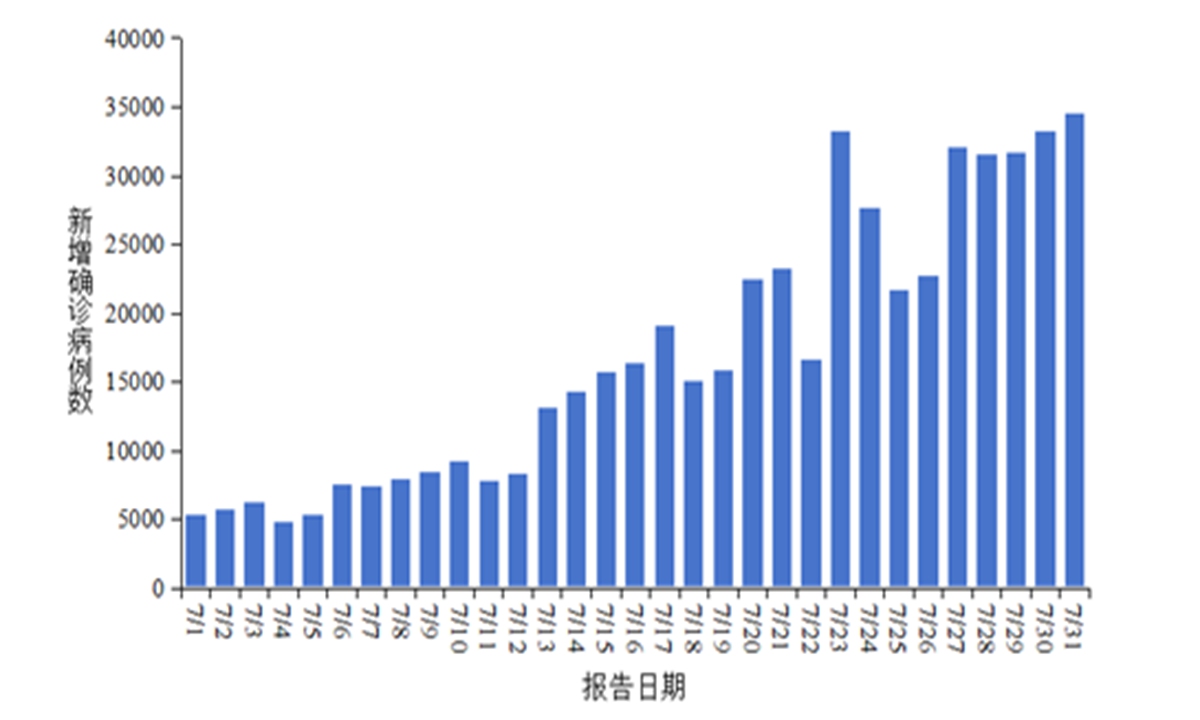
According to sentinel hospital surveillance data, from June 29-July 5 to July 27-August 2, the proportion of influenza-like illness among all outpatient and emergency visits at China's 1,041 COVID-19 and influenza sentinel hospitals edged up with slight fluctuations, standing at 4.3 percent, 4.4 percent, 4.5 percent, 4.4 percent and 4.5 percent, respectively.
During the same period, the COVID-19 positivity rate among patients with influenza-like illness in outpatient and emergency departments rose for consecutive weeks.
Several factors drove the fluctuating rise in COVID-19 cases in July. Population immunity has waned, as more than six months have passed since the last major wave of infections for most people, while continued SARS-CoV-2 mutations have reduced the protection provided by existing antibodies, Li Tongzeng, a respiratory disease medic from Beijing You An Hospital to the Capital Medical University, told the Global Times on Friday.
These factors, combined with increased travel and population mobility during the summer vacation, contributed to the recent small-scale surge. Based on patterns observed in recent years, COVID-19 infections tend to rise every six to eight months as population immunity declines, said Li.
The expert noted that while the virus continues to mutate, there is no evidence that it has become more pathogenic. Clinical data show that most patients develop only mild symptoms, with very few progressing to pneumonia or requiring hospitalization.
The Chinese CDC noted on Thursday that since COVID-19 was reclassified as a Category B infectious disease under Category B management, it has evolved into a prevalent, recurring respiratory infectious disease in China, with one to two epidemic fluctuations occurring nationwide each year.
Li also noted that residual immunity from previous infections also helps reduce disease severity, with most reinfections presenting as mild upper respiratory symptoms that resolve within about a week. The single COVID-related death reported nationwide in July further indicates that the current fatality rate remains very low.
Judging from historical epidemic patterns and current case growth trajectories, national infection figures may begin to decline in late August. Nationwide case numbers are now nearly at their peak, with declines already observed in some regions, said Li.
The Chinese CDC also said on Thursday that surveillance had not detected any variants posing major public health risks, nor had the current wave caused notable disruptions to the healthcare system.
The public is advised to take appropriate protective measures, including wearing masks when necessary, maintaining good personal hygiene, adopting healthy lifestyles and getting vaccinated as recommended.
。
Current article:http://og6nt5.panningbuquanchencaibingzhang.cyou/8wg422/20260826/82144.html
Published on:19:44:53